About Us
Ministry of commerce & industry
Tea is one of the industries, which by an Act of Parliament comes under the control of the Union Govt. The genesis of the Tea Board India dates back to 1903 when the Indian Tea Cess Bill was passed. The Bill provided for levying a cess on tea exports - the proceeds of which were to be used for the promotion of Indian tea both within and outside India. The present Tea Board set up under section 4 of the Tea Act 1953 was constituted on 1st April 1954. It has succeeded the Central Tea Board and the Indian Tea Licencing Committee which functioned respectively under the Central Tea Board Act, 1949 and the Indian Tea Control Act, 1938 which were repealed. The activities of the two previous bodies had been confined largely to regulation of tea cultivation and export of tea as required by the International Tea Agreement then in force, and promotion of tea Consumption.
Tea Board- Organisation And Functions
1. Organisation of the Board: The present Tea Board is functioning as a statutory body of the Central Government under the Ministry of Commerce. The Board is constituted of 31 members (including Chairman) drawn from Members of Parliament, tea producers, tea traders, tea brokers, consumers, and representatives of Governments from the principal tea producing states, and trade unions . The Board is reconstituted every three years.
The following are the standing committees of the Board :
(i) Executive Committee
(ii) Export Promotion Committee
(iii) Labour Welfare Committee and
(iv) Development Committee.
The Executive Committee deals with the administrative matters of the Board.
The Export Promotion Committee deals with the work in relation to the export promotion of tea.
Labour Welfare Committee guides the Board in implementation of various welfare schemes for the benefit of the plantation workers and their wards.
The Development Committee is responsible for overseeing the various developmental schemes run by the Board.
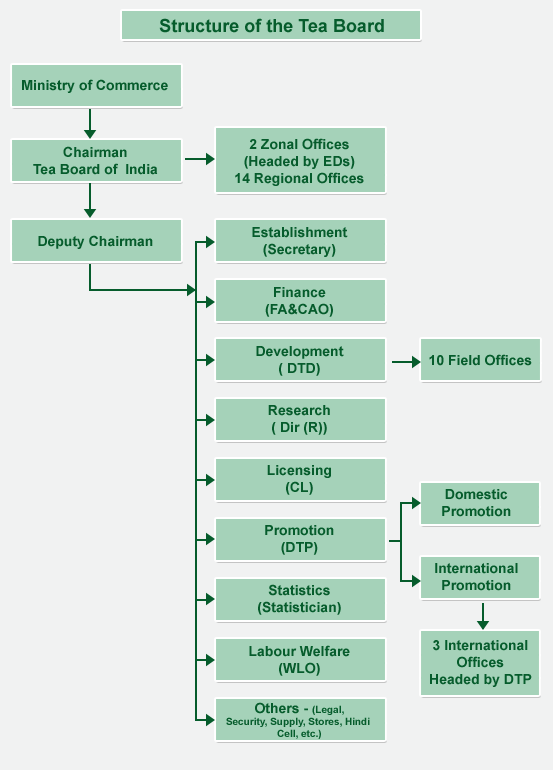
2. Administrative Set-up: The functional activities of the Board's Head Office located in Kolkata, West Bengal are as under :
a) The Secretariat headed by Secretary looks after Establishment / administrative works and co-ordinates with the various departments of the Board’s office.
b) The Establishment branch headed by Assistant Secretary looks after administrative / policy matter and deal with the staff matter of the Board’s office.
c) The Finance wing headed by Financial Advisor and Chief Accounts Officer is responsible for the maintenance of accounts, release of financial assistance to tea gardens and internal audit.
d) The Development Directorate headed by the Director of Tea Development is responsible for formulation and implementation of various developmental schemes and rendering assistance to the industry in the procurement, distribution and movement of essential inputs.
e) The Promotion Directorate headed by the Director of Tea Promotion looks after the works relating to Marketing and Promotion of tea in India and abroad.
f) The Research Directorate headed by the Director of Research is responsible for co-ordination of tea research carried out by the different tea research institutions in the country and monitoring the functions the Tea Board's own Research Station.
g) The Licensing Department headed by the Controller of licensing is responsible for issue of business licences for tea exporters and distributors, recording the ownership of all tea gardens in India and implementation of the Tea Waste (control) Order and Tea Warehousing (control) Order.
h) The Labour Welfare Department headed by Welfare Liaison Officer(North) looks after the work relating to implementation of welfare schemes of the Board.
i) The Statistics Department headed by the Statistician is responsible for the collection of Statistics relating to tea area production, tea prices, export, import, labour and all other related data and carrying out techno-economic surveys of various tea growing areas in the country including cost studies.
j) The Law Cell headed by Law Officer looks after all legal matters arising in various functional departments mentioned above.
k) Hindi Cell headed by the Deputy Director(Hindi) is responsible for the implementation of the provisions of Official Languages Act and various related measures.
l) Vigilance Cell: Tea Board's Vigilance Cell is headed by the Deputy Chairman of the Board who has been appointed as the Chief Vigilance Officer of the Board by the Central Vigilance Commission. The Cell engages itself with surveillance and preventive vigilance, in addition to taking appropriate action in matters arising out of information / complaints. The Cell attends to queries of the Government of India and the Central Vigilance Commission as and when such queries are received. Monthly and Quarterly Reports are prepared and sent to the Ministry of Commerce and the Central Vigilance Commission. The overall vigilance activities are looked after by the Chief Vigilance Officer who is assisted by the Vigilance officer
3. Functions: The Tea Board has wide functions and responsibilities under the direction of the Central Government. Briefly the primary functions of the Tea Board are as under :
a) Rendering financial and technical assistance for cultivation, manufacture and marketing of tea.
b) Export Promotion
c) Aiding Research and Development activities for augmentation of tea production and improvement of tea quality.
d) Extend financial assistance in a limited way to the plantation workers and their wards through labour welfare schemes.
e) To encourage and assist both financially and technically the unorganised small growers sector.
f) Collection and maintenance of Statistical data and publication
g) Such other activities as are assigned from time to time by the Central Government.
4. Funds for the aforesaid functions are made available to the Board by the Government through Plan and Non-Plan Budgetary allocations.
The Plan funds are being used exclusively for the activities mentioned at (a) above. Funds for all other activities mentioned above (F and g) are met from Non-Plan Budget allocation for which cess levied on tea is the major source.
Tea Cess is levied on all teas produced in India under Section 25(1) of the Tea Act, 1953. The said Act provides for levying cess upto 50 paise per kilogram of tea produced in India. Currently, however, the cess is collected at the rate of 30 paise per kg. excepting Darjeeling teas for which only 12 paise is levied. The Cess at present is collected by the Central Excise Department and credited to the Consolidated Fund of India after deducting the expenses of collection. Funds are released by the Central Government in favour of Tea Board from time to time on the basis of the sanctioned budget after due appropriation by the Parliament. Such funds received by the Board are being utilised for meeting the non-plan expenditure.
Plan Funds: Funds are provided under the plan budget with the prior approval of Planning Commission and EFC for implementing various developments, promotional and R& D schemes.
5. Offices of Tea Board :
(a) Offices in India: With Head Office located in Kolkata, West Bengal it has nineteen offices which include Zonal, Regional and Sub-Regional Offices located at the following cities/towns :
- Coonoor
- Guwahati
- New Delhi
- Siliguri
- Mumbai
- Kochi
- Coimbatore
- Silchar
- Kottayam
- Agartala
- Jorhat
- Tezpur
- Kurseong
- Palampur
- Jalpaiguri
- Dibrugarh
- Gudalur
- Kumily
- Itanagar
It also maintains four Tea Bar/Buffets.
(b) Foreign Offices: Currently Tea Board has three overseas offices located at London, Dubai, and Moscow. (The fourth and fifth office at Hamburg and New York was recently closed down). All these foreign offices of the Board are designed to undertake the various promotional measures to boost up export of Indian tea. These offices also act as a liaison office for interaction between importers of Indian tea of the respective regions as well as Indian Exporters.
6. Staff Strength: The staff position of the Board as on 31st March 2012
Group Number of Staffs
| Group |
Number of Staffs |
| A | 47 |
| B | 163 |
| C | 209 |
| D | 177 |
| Total | 596 |
| |
Form E
As per Tea (Marketing) Control Order, 2003, no manufacturer shall carry on the activities of manufacturing of tea except under a valid registration obtained under this Order in respect of each factory. As per provisions of clause 7(1), every registered manufacturer shall furnish to the Registering authority, a monthly return in Form ‘E’ or such other information as the registering authority may call for from time to time. For the convenience of the manufacturer, Tea Board has developed an online portal for filing of Form ‘E’ returns monthly. FORM-E (Monthly return) in respect of particular month is to be submitted by all the manufactures / producers as per the Tea Marketing Control Order (TMCO) 2003 to Tea Board on or before 10th of succeeding month. Details on production, sale and in-house management are to be filled up elaborately in the form. The contents of each section are given below;
I) Production details comprise of ;
- 1) Quantity of Green leaf used for production during the month
- 2) Quantity of tea produced during the month
II) Sale details comprise of;
- 1) Tea sold in auction
- 2) Tea sold in private sale
- 3) Tea exported
- 4) Tea sold at Factory gate
- 5) Tea given as gift
- 6) Tea waste generated and disposed
III) Inhouse management ;
- 1) Cost of production of tea in terms of green leaf and made tea
- 2) Cess payment
- 3) Other contributory cost involved in producing tea (annual data)
- 4) Warehouse details
- 5) Human Resource Management